
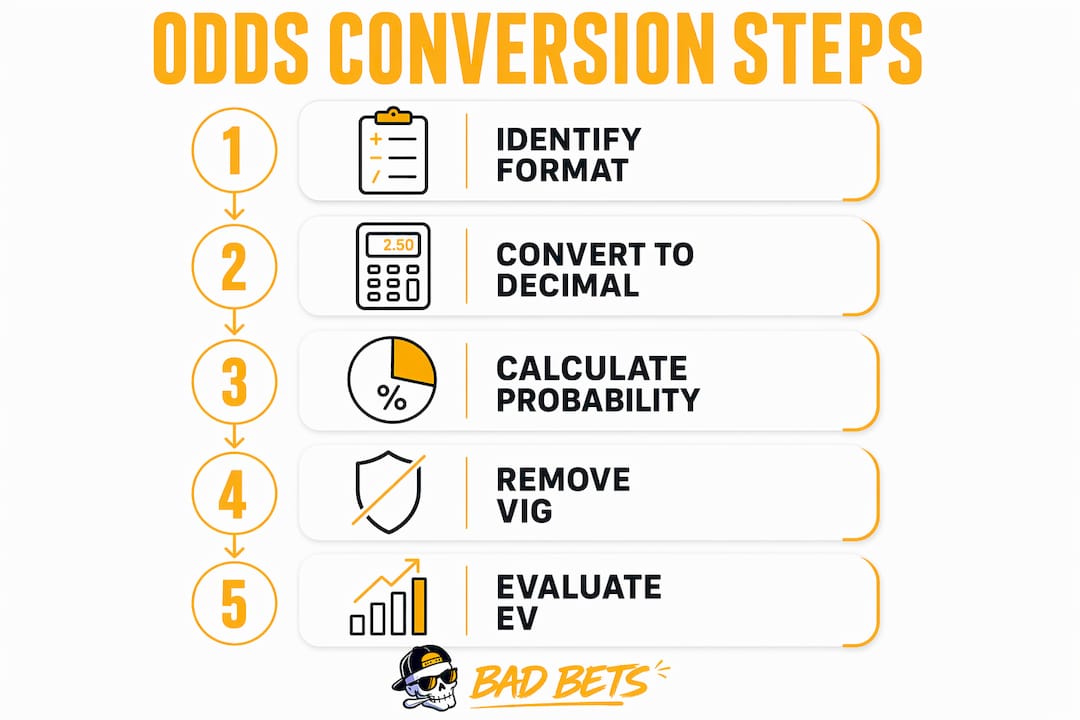
Odds conversion is the process of translating American, decimal, and fractional odds into a single unified format so you can calculate implied probability, compare lines across sportsbooks, and identify positive expected value bets. Every serious bettor needs this skill. Without it, you are comparing apples to oranges every time you shop for lines. This guide covers the exact formulas, worked examples, and the vig removal math that separates bettors who break even from those who build a long-term edge.
What is odds conversion and why does it matter?
Odds conversion is the calculation that links three different odds formats to the same underlying probability. American odds (also called moneyline odds), decimal odds, and fractional odds all describe the same bet. They just express it differently. A bettor who cannot move between formats freely is locked out of a large part of the math that drives profitable wagering.
The three formats each have a natural home. American odds dominate US sportsbooks. Decimal odds are standard across Europe, Canada, and Australia. Fractional odds appear most often in horse racing and UK markets. Knowing all three means you can read any line, anywhere, without confusion.

American odds use a baseline of $100. A positive number like +150 tells you the profit on a $100 bet. A negative number like -200 tells you how much you must risk to win $100. Decimal odds show the total return per unit staked, including your original stake. Fractional odds show profit relative to stake, written as a ratio like 3/2.
Pro Tip: Decimal odds are the easiest format for all calculations. Convert everything to decimal before you run any math, including expected value and Kelly Criterion sizing.
How to convert between American, decimal, and fractional odds
The standard conversion formulas are straightforward once you see them written out. For American to decimal: positive odds use Decimal = (American / 100) + 1, and negative odds use Decimal = (100 / |American|) + 1. So +150 becomes (150 / 100) + 1 = 2.50, and -200 becomes (100 / 200) + 1 = 1.50.
Converting decimal to fractional and back
To convert decimal to fractional, subtract 1 from the decimal odds and express the result as a fraction. Decimal 2.50 minus 1 equals 1.50, which simplifies to 3/2. To go the other direction, divide the fraction and add 1. Fractional 3/2 equals 1.5 + 1 = 2.50 decimal.
Converting American to implied probability directly
The odds-to-probability formula differs by sign. For negative American odds: Implied Probability = |American| / (|American| + 100). For positive American odds: Implied Probability = 100 / (American + 100). So -200 gives 200 / (200 + 100) = 66.7%. And +150 gives 100 / (150 + 100) = 40%.
The table below shows common odds across all three formats with their raw implied probabilities.
| American | Decimal | Fractional | Implied Probability |
|---|---|---|---|
| -200 | 1.50 | 1/2 | 66.7% |
| -110 | 1.91 | 10/11 | 52.4% |
| +100 | 2.00 | 1/1 | 50.0% |
| +150 | 2.50 | 3/2 | 40.0% |
| +300 | 4.00 | 3/1 | 25.0% |
Decimal odds represent total payout per unit stake, which makes them the cleanest format for EV and Kelly math. That is why experienced bettors convert everything to decimal before running any calculation.
Pro Tip: Bookmark an odds conversion chart or use a calculator that outputs decimal odds. The fewer manual steps between a line and your EV calculation, the fewer errors you make under time pressure.
How to calculate implied probability and remove the bookmaker's vig
Implied probability from decimal odds is calculated as (1 / decimal odds) × 100%. Decimal 2.00 equals 50% implied probability. Decimal 1.50 equals 66.7%. This is the raw probability the sportsbook is pricing into the line.
The problem is that raw implied probabilities include the bookmaker's margin, called the vig or overround. When you add up the implied probabilities for both sides of a standard NFL spread, the total exceeds 100%. That excess is the sportsbook's built-in profit.
Here is how the vig works on a typical -110/-110 spread:
- Calculate implied probability for each side: -110 gives 52.4% per side.
- Sum both sides: 52.4% + 52.4% = 104.8%.
- The vig is the amount over 100%: approximately 4.8% in this case.
- Remove the vig by dividing each side's implied probability by the total: 52.4% / 104.8% = 50.0% fair probability for each side.
That normalization step is what separates raw implied probability from fair implied probability. Distinguishing these two figures is critical for accurate expected value betting. If you skip vig removal and use raw probabilities in your EV formula, you will systematically underestimate the edge you need to beat the book.
A more detailed example: suppose the Lakers are priced at -115 and the Celtics at +100. The Lakers' raw implied probability is 53.5% and the Celtics' is 50.0%. The sum is 103.5%. After normalization, the Lakers' fair probability is 53.5% / 103.5% = 51.7%, and the Celtics' fair probability is 50.0% / 103.5% = 48.3%.
Pro Tip: Always remove the vig before plugging probabilities into any EV formula. Using raw probabilities makes every bet look worse than it is, and you will pass on edges that are actually profitable.
How to use odds conversion to find positive EV bets
Positive expected value (+EV) is defined as any bet where EV% = (fair probability × decimal odds − 1) × 100 is greater than zero. A positive result means the bet returns more than it costs over a large sample. A negative result means the opposite.
The expected value formula in decimal odds is: EV = (True Probability × Decimal Odds) − 1. A result of +0.05 means a 5% expected profit per unit bet over time. Here is how EV margins break down in practice:
- 0–2% EV: Slight edge. Worth taking with small stakes.
- 2–5% EV: Strong edge. A core part of any value betting strategy.
- 5–10% EV: Excellent edge. Act fast because these lines move quickly.
- 10%+ EV: Rare. Usually signals a stale line or data error. Verify before betting.
Finding a fair line to compare against
The EV formula requires a fair probability, and that means you need a reference line with low vig. Sharp sportsbooks like Pinnacle carry low margins and reflect professional market consensus. Their lines serve as a reliable proxy for the true fair price. If you find a line at another book that is significantly better than Pinnacle's, that gap is your potential edge.
Sizing bets with the Kelly Criterion
Once you have a positive EV bet, the Kelly Criterion tells you how much to stake. The formula is: Kelly % = (BP − Q) / B, where B is decimal odds minus 1, P is your fair probability, and Q is 1 − P. Most experienced bettors use fractional Kelly, typically 25–50% of the full Kelly output, to reduce variance while preserving the mathematical edge.
The biggest mistake bettors make is not the math. It is the discipline. Knowing the EV formula is easy. Sticking to flat units or fractional Kelly when you are on a cold streak is where most bettors fail. +EV betting is a mechanical strategy. It requires a large sample size and consistent staking to let the statistical edge materialize.
Common pitfalls to avoid:
- Ignoring the vig: Using raw implied probabilities inflates your perceived edge.
- Chasing moved lines: A line that has already moved against you is no longer the same bet.
- Emotional bet sizing: Doubling down after losses destroys bankroll math.
- Skipping line shopping: Poor bankroll management and ignoring vig are the two most common reasons bettors lose despite understanding +EV concepts.
Pro Tip: Track every bet with the EV% at the time of placement, not the outcome. Outcomes are short-term noise. Your EV log is the only honest measure of whether your process is working.
Key Takeaways
Odds conversion is the foundation of every profitable betting decision, because it connects raw odds to fair probability and expected value in a single chain of math.
| Point | Details |
|---|---|
| Convert to decimal first | Decimal odds simplify every calculation, including EV and Kelly Criterion sizing. |
| Remove the vig before calculating EV | Raw implied probabilities include the bookmaker's margin and will distort your edge estimate. |
| Use a sharp line as your fair price | Low-vig books like Pinnacle provide the most reliable reference for true fair probability. |
| EV% above 2% is a strong edge | A 2–5% EV margin is worth targeting consistently as part of a value betting strategy. |
| Discipline beats math knowledge | Knowing the formulas means nothing without consistent staking and a large sample size. |
Why most bettors never get past the formulas
I have seen bettors who can recite the Kelly Criterion formula but blow up their bankroll inside a month. The math is not the hard part. The hard part is treating betting like a process rather than a series of individual outcomes.
The single biggest shift I made was converting every line to decimal before touching a calculator. It sounds trivial, but it cuts out a full step of mental translation and reduces errors when you are moving fast on a line that is about to close. Decimal odds outperform American and fractional for calculations because they represent total return explicitly. Once you internalize that, the EV formula becomes second nature.
The other thing most guides skip is market timing. A 7% EV edge on a line that has already been bet down to 2% is not a 7% edge anymore. Market volatility erodes excellent edges fast. The bettors who capture those lines consistently are the ones who have alerts set, act within minutes, and focus on markets that are slow to update, like early-week NFL props or overnight MLB lines.
Patience matters more than frequency. You do not need to bet every game. You need to bet the right games at the right price, size them correctly, and repeat that process hundreds of times. The edge compounds. The variance smooths out. That is the whole game.
— Max
Badbets puts the math to work for you
Knowing the formulas is one thing. Having a model that runs them across every MLB, NFL, NBA, and WNBA game every day is another level entirely.

Badbets uses a math-based model to identify mispriced lines across major sports, flagging the bets where the sportsbook's number does not match the true probability. Every pick comes with the reasoning behind it, no paywalls, no upsells. You can see the model picks and live shot charts for free, and use them alongside your own odds conversion work to sharpen your edge. When you combine a solid understanding of implied probability with a data-driven pick service, you stop guessing which games have value and start acting on it.
FAQ
What is odds conversion in sports betting?
Odds conversion is the process of translating American, decimal, or fractional odds into a common format, typically to calculate implied probability or expected value. It lets bettors compare lines across different sportsbooks and formats accurately.
How do I convert American to decimal odds?
For positive American odds, use Decimal = (American / 100) + 1. For negative American odds, use Decimal = (100 / |American|) + 1. So +150 becomes 2.50 and -200 becomes 1.50.
What is implied probability and how do I calculate it?
Implied probability is the win percentage priced into a set of odds. From decimal odds, calculate it as (1 / decimal odds) × 100%. Decimal 2.00 equals a 50% implied probability.
What is the vig and why does it matter for +EV betting?
The vig is the bookmaker's margin, built into odds so that the sum of implied probabilities across all outcomes exceeds 100%. Removing it by normalizing each side's implied probability gives you the fair probability needed for accurate EV calculations.
What counts as a positive EV bet?
A bet is positive EV when (fair probability × decimal odds − 1) × 100 is greater than zero. An EV of 2–5% is a strong edge worth targeting as part of a consistent value betting strategy.