
Hedging bets is defined as placing a second, opposing wager after your original bet to lock in profit or limit potential loss. The practice trades some upside for certainty, making it one of the most practical risk management tools available to sports bettors. Unlike arbitrage, which is planned before any money goes down, hedging is reactive. You place it after your original bet, in response to how the market or game has moved. Mastering this distinction separates disciplined bettors from those who bleed bankroll through emotional decisions.
What is hedging bets and when does it make sense?
Hedging bets works best in specific, identifiable situations. Knowing those situations before they arrive keeps you from making reactive decisions under pressure.
The clearest cases for hedging include:
- Large futures bets nearing resolution. You bet $200 on a team to win the Super Bowl at +1500 in September. By February, they are in the championship game. Your potential payout is massive, but so is the risk of walking away with nothing.
- Parlays with one leg remaining. You have hit four of five legs on a parlay. The final leg is live. A hedge on the opposing outcome can lock in profit regardless of the result.
- Live betting swings. A game shifts dramatically in the first half. The odds on the opposing side now offer real value relative to your original position.
- Bankroll protection needs. Your original bet represents a significant portion of your bankroll. Protecting that capital matters more than chasing the full payout.
Hedging is less advisable when your original bet is small, when the odds movement is minimal, or when the bookmaker margin on the hedge bet would eat most of the guaranteed profit. Frequent, impulsive hedging compounds bookmaker margin costs and hurts long-term expected value.
Emotional influence is the hidden enemy here. Fear of losing a big payout triggers hedging instincts even when the math does not support it. The correct trigger for a hedge is a logical calculation, not a gut feeling.
Pro Tip: Set a hedging threshold before you place any original bet. Decide in advance: "If my potential profit reaches EX, I will hedge to lock in BY." That pre-commitment removes emotion from the equation entirely.
How to calculate the right hedge bet
The math behind hedging is straightforward once you know the formula. The standard calculation for a full hedge stake is:
Hedge Stake = (Original Stake × Original Odds Payout) / (Hedge Odds Payout + 1)
Here is how that plays out in practice. Say you bet $100 on a team to win a championship at +800 odds. Your potential payout is $900 (your $100 stake plus $800 profit). The opposing team is now priced at even money (+100) going into the final game. Using the formula:
Hedge Stake = ($100 × 9) / (2 + 1) = $900 / 3 = $300
Placing $300 on the opposing side at even money returns $600 if that team wins. Your net position: $600 minus $300 hedge stake minus $100 original stake = $200 guaranteed profit, regardless of outcome.
| Scenario | Original Stake | Original Odds | Potential Payout | Hedge Stake | Guaranteed Profit |
|---|---|---|---|---|---|
| Futures bet | $100 | +800 | $900 | $300 | $200 |
| Parlay (last leg) | $50 | +600 | $350 | $175 | $125 |
| Live bet swing | $200 | +250 | $700 | $350 | $150 |
A partial hedge works differently. Instead of eliminating all risk, you guarantee a smaller profit while keeping some exposure to your original bet's upside. You calculate the stake needed to secure your desired floor profit, then place only that amount. This approach suits bettors who believe their original bet still has a real chance but want a safety net below a certain loss threshold.
The most common calculation error is ignoring bookmaker margin. Every sportsbook builds a vig into its odds. When you hedge, you pay that margin twice. A parlay with a 45% win chance paying $1,200 may carry an expected value of $512.50 unhedged, but hedging locks in $400 profit while reducing that expected value. The trade-off is real and worth calculating explicitly before you act.
Pro Tip: Use a free online hedge calculator for parlays with multiple legs or complex live odds. Manual math under time pressure during live betting leads to errors that cost you money.
How to execute a hedge bet step by step
Execution is where most bettors lose money they should have kept. The calculation is only half the job.
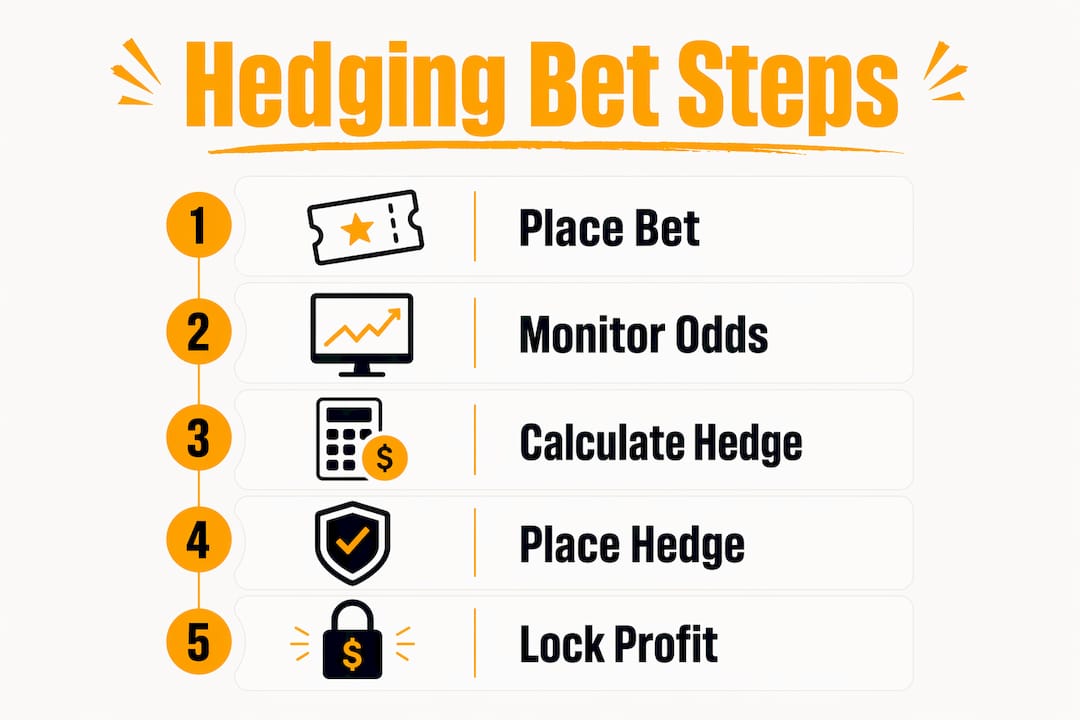
- Monitor your original bet's status. Track odds movement in real time. For futures, check lines daily as the event approaches. For live bets, watch the game and the live odds feed simultaneously.
- Calculate your hedge stake. Use the formula above or a hedge calculator. Know your guaranteed profit number before you touch a second sportsbook.
- Shop for the best odds on the hedge side. The difference between -110 and -120 on a $300 hedge stake is meaningful. Multiple sportsbook accounts are not optional for serious hedgers. They are the mechanism that makes hedging cost-effective.
- Place the opposing bet at the best available odds. Do not delay once you have decided. Odds shift fast, especially in live markets.
- Record both bets and your net position. Write down the original stake, the hedge stake, and the guaranteed profit. This record keeps your bankroll accounting clean.
- Resist adjusting after the hedge is placed. Once you lock in a guaranteed profit, the job is done. Adding a third bet to "improve" the position usually just adds more bookmaker margin.
Timing matters differently depending on bet type. For futures bets, you have days or weeks to find the right moment. For live bets, the window can close in minutes. Having accounts funded and ready at multiple books before the event starts is the single biggest execution advantage you can give yourself.
Impulsive hedging during live games is the most expensive mistake casual bettors make. The odds swing, panic sets in, and a hedge gets placed at poor value. The result is a guaranteed loss instead of a guaranteed profit.
Common hedging mistakes and how to avoid them
Most hedging errors fall into a small number of repeating patterns. Recognizing them in advance prevents expensive lessons.
- Emotional hedging without math. Placing a counter bet out of fear rather than calculation destroys expected value. The hedge must be justified by the numbers, not by anxiety.
- Over-hedging on small bets. When the original stake is modest, the bookmaker margin on the hedge often exceeds the guaranteed profit. The math simply does not work.
- Confusing hedging with arbitrage. Arbitrage is pre-planned before any bet is placed, exploiting price differences across books simultaneously. Hedging is reactive. Treating them as the same thing leads to poor timing and incorrect stake sizing.
- Skipping partial hedges. Many bettors think hedging is all-or-nothing. A partial hedge can secure a profit floor while keeping upside alive. Ignoring this option leaves money on the table.
- Ignoring long-term bankroll impact. Every hedge pays the bookmaker margin twice. Done selectively, that cost is worth it. Done habitually, it erodes your bankroll faster than losing bets.
"Hedge only for bankroll preservation or clear market reasons. Hedging for emotional comfort is just paying extra to feel better about a bet you already made."
Setting a personal hedging threshold solves most of these problems. Decide before the season what profit level triggers a hedge on your futures bets. Stick to that number regardless of how the game feels in the moment.
Integrating hedging into your overall betting strategy
Hedging is an insurance policy, not a profit-generating tool. The premium you pay is the potential profit you sacrifice. Smart bettors accept that cost consciously and selectively, not reflexively.
The distinction between aggressive and conservative hedging styles is real and worth understanding. An aggressive bettor might hedge only when a futures bet reaches a 3x return on the original stake, accepting more variance in exchange for higher average payouts. A conservative bettor might hedge any time a guaranteed profit exceeds their original stake, prioritizing capital protection over maximum return. Neither approach is universally correct. The right threshold is personal and depends on bankroll size, risk tolerance, and the specific bet type.
Bankroll management and hedging work together. A bettor who never risks more than 2–5% of their bankroll on a single bet faces less pressure to hedge, because no single loss is catastrophic. A bettor who overextends on a futures bet faces a binary outcome and feels compelled to hedge even at poor odds. Sizing bets correctly from the start reduces the emotional pressure that leads to bad hedges later.
The most disciplined approach treats hedging as a response to market movement, not a default behavior. When the odds shift significantly in your favor after the original bet, a hedge captures real value. When nothing has changed, there is no reason to act. Selective hedging in response to genuine market moves is what separates bettors who use it well from those who use it as a crutch.
Key Takeaways
Hedging bets works best as a selective, math-driven tool for locking in profit or protecting bankroll, not as a default response to fear or uncertainty.
| Point | Details |
|---|---|
| Define your hedge trigger | Set a profit threshold before placing the original bet to remove emotion from the decision. |
| Use the hedge formula | Calculate stake as (Original Stake × Original Payout) / (Hedge Odds Payout + 1) for a full hedge. |
| Consider partial hedges | A partial hedge secures a profit floor while keeping some upside from the original bet. |
| Shop odds across books | Multiple sportsbook accounts reduce the cost of hedging by securing the best available odds. |
| Hedge selectively | Frequent hedging compounds bookmaker margin and reduces long-term expected value. |
The uncomfortable truth about hedging I had to learn the hard way
Most bettors discover hedging after a near-miss. A parlay hits four legs, the fifth is live, and the panic sets in. I have been there. The instinct is to hedge immediately, at whatever odds are available, just to guarantee something. That instinct is almost always wrong.
The bets I regret most are not the ones I lost outright. They are the ones where I hedged at terrible odds because I could not tolerate the uncertainty. I paid the bookmaker margin twice, locked in a fraction of the potential profit, and watched the original bet win anyway. The math was never on my side in those moments. The fear was.
What actually works is treating hedging the way a good insurance buyer treats a policy. You buy it when the premium is fair and the risk is real, not every time you feel nervous. Partial hedges changed how I approach futures bets entirely. Locking in a guaranteed floor profit while keeping some exposure to the full payout is almost always a better position than going all-in on the hedge or ignoring it completely.
Having accounts at three or four sportsbooks before a big futures bet resolves is not optional. It is the difference between hedging at -110 and hedging at -130. That gap compounds across a season. The bettors who execute hedges well are almost always the ones who prepared the infrastructure before they needed it.
— Max
How Badbets helps you make smarter hedging decisions
Knowing when and how to hedge requires real-time data and a clear read on where the value sits in any given game or market.

Badbets publishes free model picks and live analytics for MLB, WNBA, NFL, and NBA games every day. The platform's math model identifies mispriced lines, which is exactly the kind of information that tells you whether your original bet still holds value or whether a hedge makes sense. When you can see the model's edge on both sides of a game, the hedging decision becomes a calculation instead of a guess. No paywalls, no upsells. Just the numbers you need to act with confidence.
FAQ
What does hedging a bet mean?
Hedging a bet means placing a second wager on the opposing outcome of your original bet to lock in profit or reduce potential loss. It trades some upside for a guaranteed return.
When should you hedge a sports bet?
Hedge when a large futures bet or parlay is nearing resolution and the guaranteed profit justifies the cost of the opposing wager. Avoid hedging purely out of fear or when the bookmaker margin exceeds the guaranteed gain.
What is the formula for calculating a hedge bet?
The standard formula is: Hedge Stake = (Original Stake × Original Odds Payout) / (Hedge Odds Payout + 1). This calculates the stake needed to guarantee equal profit on either outcome.
What is the difference between hedging and arbitrage?
Arbitrage is planned before any bet is placed, exploiting simultaneous price differences across books. Hedging is reactive, placed after the original bet in response to market or game movement.
Does hedging reduce expected value?
Yes. Every hedge pays bookmaker margin on a second bet, which reduces long-term expected value. Selective hedging for bankroll protection or genuine market reasons is worth that cost. Habitual hedging is not.